
A short Holiday in Munich and Dachau
Recently, during one of the long weekends during spring, we, as a family, did a short holiday in Munich and Dachau. In this article, I shall be taking my readers through our experience in these two cities, the places we saw, the things we did, etc. It also includes information about travel to and within these cities, accommodation etc. With this article, I hope to help my readers plan their holiday in these cities.

So, let’s start.
Munich is the capital of the southern state of Bayern in Germany. It is also the most populous city and is home to many foreigners. This city is most popular for its October fest and beer culture. It also has a rich history and a unique culture that attracts many from all over the world. Dachau is a smaller city located 20 km northwest of Munich. Dachau is known for its concentration camp, which housed many prisoners during the Second World War.
We spent about three days in these cities and visited many attractions.
Reaching Munich and Dachau
By Car
We live in Darmstadt, which is about 400 km northwest of Munich. We drove to Munich, which took about 4 hours. Both Munich and Dachau are well connected by road, so if you live somewhere close to Munich, reaching by car is the fastest and most convenient way.
If you don’t have a car, you can consider booking a SIXT rental car on their official website. We have used SIXT on our trips and found their cars to be of excellent quality, their service fantastic, and their prices reasonable.
By Public Transport:
Both Munich and Dachau are well-connected to major cities in Germany and Europe. You can book Deutsche Bahn’s official website to book tickets to reach Munich/Dachau by train:
Alternatively, you can compare all the options to reach Munich/Dachau on the OMIO website.
By Air
Munich Airport, called München Flughafen, is the second busiest airport in Germany after Frankfurt Airport. Their official website is: https://www.munich-airport.de/
If you plan to arrive in Munich by flight, check out your options here.
Accommodation in Munich and Dachau
Munich is well connected by public transport so it is ok if you stay a bit far from the city centre. That way, you will get a bigger accommodation for a lesser price.
If you want to avoid too much travel within the city, you can stay in the city centre. Try to find a location near Altstadt (the old town). Since you will be spending a lot of time in that area, having a place to stay nearby will give you the choice of coming back and relaxing for a while in between if all the walking, etc, makes you tired. Also, if you stay in Altstadt and say you have reached there by car, you can leave your car parked at your hotel/apartment. That way, you can save yourself the trouble of looking for parking and the associated additional expenses.
During our visit, we couldn’t find any accommodation in Munich that suited our needs, so we booked an apartment in Dachau instead. The prices were much lower than in Munich, and we got to live in a big-sized apartment very close to the train station on Bahnhofstrasse in Dachau. It took us 5 minutes to reach Dachau train station on foot and 30 minutes (by S Bahn) to reach Munich, which was quite convenient.
You can find accommodations in Dachau here.
You can check out accommodations in Munich here.
Travelling within Dachau and Munich
MVV is the company that handles public transport in Bavaria. Their website is: https://www.mvv-muenchen.de/en/index.html
You can download their app and buy tickets online, buy tickets at the station’s ticketing counter, or use the ticketing machines.
If you travel as a family, a group ticket works best.
If you plan to include museums, tours, theatre etc, in your visit, you can buy the Munich City Card, which allows you to use public transport and offers discounts on many attractions. To check out everything included in the Munich City Card, click here.

To find out which bus/tram/S Bahn, etc, you need to take, simply use Google Maps and put your source and destination. Switch to the public transport option, and you can see your travel options between the desired locations.
If you are not comfortable using public transport, you can opt for the Hop On Hop Off Bus. This is specially designed for tourists and covers most of the important attractions in the city. The advantage of taking this bus is that you save time. You travel from one tourist attraction to another instead of wasting your time in parts of the city you are not interested in (which happens with regular public transport). Also, you avoid huge crowds, which is common during peak season.

Since we stayed in Dachau and wanted to avoid the hassle of driving in the crowded streets of Munich and looking for parking spots, we took the S bahn from Dachau to Munich, which plies every 30 minutes. It was a 30-minute train ride and quite comfortable.
Our Experience in Munich and Dachau
Day 1:
Our trip started on a Friday. We left Darmstadt around 8 a.m. and arrived in Dachau around 12:30 p.m. We checked into our apartment, unpacked, relaxed for some time, and then decided to leave for Munich.
As mentioned, we stayed close to the Dachau train station (Dachau Bahnhof), just a 5-minute walk from our apartment. We bought the ticket at the ticketing office and took the S-Bahn, which took 30 minutes to travel by train. (I have already shared information about public transport in Dachau and Munich). We alighted at Karlsplatz.
From Karlsplatz, this is the path we followed on foot:

Let me explain each of these:
Karlsplatz (Stachus):
Karlsplatz, also known as Stachus, is one of Munich’s most famous squares. It is also a transport hub. S-Bahn, subway, tram, night bus – pretty much every important means of transport in Munich serves the Stachus, which means that from here, you can reach almost every destination in the city. This is the place for a lovely fountain in summer and ice skating in the winter. You cross the Karlstor ( Karls Gate) from Karlsplatz, one of the last remaining Munich City Gates. It also marks the beginning of the pedestrian zone.
Learn more about Karlsplatz here.

From Karlsplatz, we walked about 900 mts and reached Asamkirche.
Asamkirche
Asamkirche is a Catholic church built in the mid-18th century by the Asam brothers. It served as a chapel for personal use. It showcases southern German late Baroque architecture and design and is considered one of the most important monuments in the state.
When we visited, the exterior walls were undergoing renovation work, and it took us a moment to figure out where the church’s entrance was. But after entering, we were pleasantly surprised to see its lovely interiors.
Learn more about Asamkirche here.

After spending some time at Asamkirche, we walked about 600 mt and reached Viktualian Markt
Viktulian Markt
The Viktualienmarkt is a food market in the city centre of Munich. It started in the early 19th century and has since held a food market every day except Sundays and public holidays. There are permanently erected stalls and some temporary stands, which are put up based on the season. Beer cellars, a gourmet market, and several fountains characterize the area. During the Second World War, the square was badly damaged by air raids. People considered abandoning the market entirely and building high-rise buildings in a prime location on this valuable property. But the city administration brought the Viktualienmarkt back to life at considerable financial expense.
The stands offer bread, flowers, fruit, fish, meat, dairy, juices, handicrafts and much more. Today the market is a shopping destination for Munich residents and a tourist attraction.
Learn more about Viktualienmarkt here.

If you are interested, you can book a 2.5-hour Gourmet Food Tour here and try regional and international delicacies.
After visiting Viktualienmarkt, we walked about 400 mts to reach Marianplatz.
Marianplatz
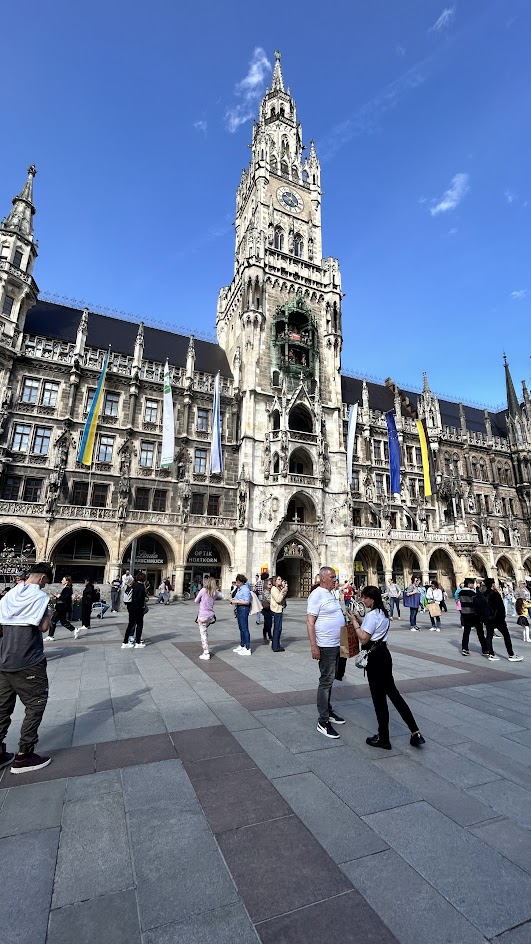
Marientplatz is undoubtedly the most popular place in the city centre of Munich. It is characterised by many historical buildings, such as the old and new townhouse (Called Rathaus), Fischbrunnen, and Der Alte Peter, the oldest Parish church in Munich. This place is full of activity, with street performers, cafes, restaurants, shops, and plenty of tourists and locals.
Learn more about Marienplatz here.

After watching a lovely street performance at Marienplatz, we walked 350 mts to Frauenkirche.
Frauenkirche
Frauenkirche, also known as Munich Cathedral, is a late 15th-century church and one of the most important landmarks in Munich. Its two towers rise almost 100 meters. The south tower is open to visitors and offers a view of the entire city. The inside of the church is also open to the public outside of church services. Highlights for visitors include the Wittelsbacher monument, the bishop’s crypt, and the Devil’s Step.
Learn more about Frauenkirche here.

A 600 mt walk from Frauenkirche leads to Munich Residence.
Munich Residenz
The Munich Residenz was the seat of government and residence of the Bavarian dukes, electors and kings from 1508 to 1918. What began in 1385 as a castle in the northeastern corner of the city was transformed by the rulers over the centuries into a magnificent palace, its buildings and gardens extending further into the town.

The rooms and art collections, which span a period that begins with the Renaissance and extends via the early Baroque and Rococo epochs to Neoclassicism, bear witness to the Wittelsbach dynasty’s discriminating taste and political ambition.
Much of the Residence was destroyed during the Second World War, and it was gradually reconstructed from 1945 onwards. Today, the museum, the Treasury, and the Cuvilliés Theatre comprise one of Bavaria’s largest museum complexes.

We wanted to see the Munich Residenz from the inside. We bought tickets at the entrance and explored the museum on our own. Here I would mention that the palace is huge, and if you explore it on your own, you may feel a bit lost. There are so many exhibits that you may wonder what to see and leave if you have limited time. In such a situation, you can consider taking a 2.5 hour guided tour. In this tour, through a professional guide, you can see and understand the palace with its rich history, its design, etc. If interested, you can also book a concert at Munich Residenz and witness a performance by members of the Munich Philharmonic.

Learn more about Munich Residenz here.
After we visited Munich Residenz, it was already evening and we were ready to relax and enjoy some local food and beer. So we took a 500 mt walk and reached Hofbräuhaus.
Hofbräuhaus
Usually, I don’t include restaurants in ‘places to visit’ in my articles. I have included Hofbräuhaus because it is not just a restaurant, pub, or brewery. It is an important part of the history of Munich and Germany; from that perspective, it is a must-visit in Munich.
Hofbräuhaus was founded in 1589 by the Bavarian Duke Wilhelm V. Its initial purpose was to serve beer to the court. The place also finds a mention during the Thirty Years’ War, in which Swedish troops besieged Munich. The threatened looting and destruction of Munich could have been prevented by paying the Swedes, among other things, 23,168 litres from the Hofbräuhaus as the price for sparing Munich.
In 1828, King Ludwig I opened the Hofbräuhaus to the public. He approved public serving and catering, establishing the Hofbräuhaus as an Inn.
In 1920, the National Socialist German Workers’ Party (NSDAP) was founded in the Hofbräuhaus. Adolf Hitler announced the 25-point program, the party program of the NSDAP, as part of the founding.

Hofbräuhaus is one of the oldest pubs in the world and undoubtedly the most popular place in Munich. It has been featured in many films and documentaries. It serves great beer and delicious Bavarian food. So, after coming to Munich, missing this place was out of the question. And it must say it was worth all the hype.

We had a sumptuous Bavarian dinner and enjoyed local beer. Everything was wonderful, and we had a great end to our first day in Munich. My review of the place is posted here.
If you want to learn more about Hofbräuhaus, you can also take a guided tour. On the tour, you can listen to anecdotes and interesting facts about the business and pay an exclusive visit to the Hofbräuhaus ballroom (otherwise only open in the evening). From the gallery, you can take impressive photos as a personal souvenir.

If you are interested in checking out other beer halls and breweries of Munich, you can do a 3.5 hour tour and visit various beer halls in the city and enjoy beer and local Bavarian food.
You can also check out the official website of Hofbräuhaus: https://www.hofbraeuhaus.de/
After dinner, we took the S bahn from Marianplatz and returned to our apartment in Dachau.
Note that we saw all the places mentioned above on our own. Another way to explore the old town is to take a Munich Old Town Guided Walking Tour, in which a professional guide takes you around the old city and tells you many interesting things about the city, its history, monuments, culture etc. You get to see the city from the eye of a local.
Here are some more pictures that we took in Munich on our first day:
Pictures we took on our first Day in Munich


Day 2:
On this day, we planned to visit the Deutsches Museum in the morning and the English Garden in the evening.
We again bought a group day ticket at Dachau and took the S bahn from Dachau Bahnhof to München Isartor. From there, we walked about 300 mts to reach Deutsche Museum.
Deutsches Museum
Deutsches Museum is a science museum and a treasure trove for all science lovers. Both adults and children have plenty to see and experience in this museum. Plenty of exhibits in Maths, Robotics, Aerospace, Electronics, Music showcase the advances we have made in these areas, etc. They also organize events in the museum all through the day. Participation in these events and demos is included in the ticket, and you can attend them as per the schedule posted on the displays at different places in the museum. The museum is quite big, and one can spend an entire day there, still being left with many things to see and explore.

The official website of the museum is: https://www.deutsches-museum.de/
The ticket to the museum can be purchased at the entrance.
We spent about five hours in the museum.
After that, we stopped for lunch at a nearby restaurant. My review of the restaurant is posted here.
After lunch, we headed to the English Garden.
Englischer Garten
In 1789, Elector Karl Theodor ordered the creation of a public park on the Isar River. It was intended to provide recreation for the army but opened in 1792 as a people’s park for the 40,000 citizens of Munich at the time. The park was named “English Garden” (Englischer Garten) because it was not laid out as a geometrically designed French Baroque garden but in the style of an English landscape park.
Learn more about English Garden here.

The English Garden is one of the largest inner-city parks in the world. It is so big that you can’t visit every part of it in one visit. Plan to at least see the following four places:
- Monopteros (a small temple-like structure): Known for lovely views of the city
- Eisbachwelle: Watch the surfers.
- Chinese Tower: Nice place to hang around, with a beer garden etc
- Kleinhesseloher See (a little lake in the park): For the best views, visit the Seehaus restaurant.

You can also opt for a English garden walking tour to best understand the place.
After the English Garden Visit, we returned to our apartment in Dachau.
Here are some more pictures from our second day in Munich.


Day 3:
On this day, we planned to visit the Dachau Concentration Camp, spend half a day there and then head back to Darmstadt, where we live.
Dachau Concentration Camp
The Dachau Concentration Camp, called KZ-Gedenkstätte Dachau, is a must-visit when in Dachau. This place has been on our bucket list for a long time, and I am glad we could finally visit it. Whether you are a history lover or not, you will certainly have much to learn from this place of such historic importance.

The Dachau Concentration camp was opened in 1933. For about twelve years, more than 200,000 prisoners from over 40 nations were imprisoned in the Dachau concentration camp. Out of these, at least 41,500 persons died here of hunger and illness, from the torture they suffered, were murdered, or perished from the consequences of their imprisonment.
After U.S. Army units liberated the prisoners on April 29 1945, the American military government used the former prisoner camp as a Displaced Persons camp. From July 1945, the grounds served as an internment camp for suspected Nazi perpetrators after the Dachau Trials.
Today, this is a place of commemoration and remembrance. To the present day, it is the goal of the Dachau Concentration Camp Memorial Site to remember the suffering and death of the prisoners and to facilitate and foster analysis and discussion of Nazi crimes.
The visit to the camp doesn’t cost anything. But if you wish for a guided tour, you have to pay.
We reached the site at 10 am. After buying tickets for the guided tour (at 11 am), we headed to the Kinosaal (theatre) to see a 38-minute film about the camp. Then, we returned to the reception area, where our tour started. It was an English tour, and our guide took us to all the places, including the prisons, the attendance call area, the gas chambers, the barracks, the cemetery, etc. The tour lasted about 2.5 hours and was very interesting and informative.
Check out their official website to know more: https://www.kz-gedenkstaette-dachau.de/en/
Here are some more pictures from the Dachau Concentration Camp:


After the camp visit, we stopped for a quick snack at the cafe at the site. Then we started for Darmstadt. On the way, we stopped for lunch and continued our drive. By evening, we were back home.
As I mentioned, you can take the S bahn to travel between Munich and Dachau. From Dachau Bahnhof, take bus 726 to reach Dachau, KZ-Gedenkstätte. From there, a 200 mt walk leads you to the site.
If you are not comfortable travelling on public transport on your own, you can book a day visit to Dachau Camp from Munich with a guide.
If you don’t want to rely on public transport, you can book a Dachau Concentration Camp Private Tour by Car.
Our trip to Munich felt like a dive into the history of Germany, and we loved the entire experience.
It was a short trip for us, and these are the places we could have visited.
If you have more days in Munich, you can add the following to your itinerary. Please note that if you wish to see most of these places, plus the ones we saw, it is best to buy the Munich City card. I have already shared the link at the beginning of this article.
- A visit to the Nympheberg Palace: Official website: https://www.schloss-nymphenburg.de/englisch/palace/. Buy tickets for your visit here.
- Watch a match at Allianz Arena or book a visit to the Museum and stadium: The Official Website is https://allianz-arena.com/de. You can also book an FC Bayern Munich Allianz Arena Tour here.
- Olympiapark: Official Website: https://www.olympiapark.de/de
- BMW Welt and BMW Museum: Official Website: https://www.bmw-welt.com/en/index.html
- Hellabrunn Zoo: Official Website: https://www.hellabrunn.de/en/. Book a ticket with a private transfer in Munich here.
- See Life Munich: Official Website: https://www.visitsealife.com/muenchen/en/. Buy a day ticket to See Life here.
There are many more places to see in Munich, but I have added some of the important ones.
If you are in Munich, you can also plan day trips to the following places. If you have more days, extend your holiday in these places:
- Rothenburg (248 km from Munich): Read my article about our short family holiday in Rothenburg. Book a day trip to Rothenburg here.
- Nuremberg (169 km from Munich): Read my article about our 3 days in Nuremberg and Ingolstadt. Book a day trip to Nuremberg here.
- Lindau (183 km from Munich): Read my article about 2 days in Lindau.
- Innsbruck (162 km from Munich): Read my article about 2 days in Innsbruck, Austria.
- Neuschwanstein & Linderhof Castle (125 km from Munich): Book a day trip here.
I hope my readers have found this article interesting and informative.
To read about other holidays, click here.


Leave a Reply