

KRKA National Park and Zadar
Croatia is a small country in the eastern part of Europe. It lies on the eastern shores of the Adriatic Sea. On the western shore is Italy. A large part of west Croatia lies along the sea. Apart from the lovely pebbled beaches and emerald green waters, the country is blessed with lovely rivers, waterfalls and many lovely historical sites which tourists can enjoy.
During one of the Easter vacations, we took a 9-day holiday in Croatia, Europe, in which we covered the Dalmatia region and visited the following places:
1. Dubrovnik
2. Ston
3. Mljet
4. Split
5. KRKA National Park
6. Zadar
In this article, I share our experience during the fourth leg of our holiday, one day in KRKA National Park and two days in Zadar This includes information about travel, accommodation, the places we visited, restaurant reviews, and some tips based on my experience. I hope my readers find this article helpful when planning their holiday in Split.
Look at the map below to better understand the locations and the plan. The areas marked in grey, blue, purple, and orange comprise the Dalmatian region, which includes all the places mentioned in the list above.

First, let’s look at the itinerary we followed in Croatia:
9 Days Holiday Itinerary in Croatia:
Day 1: Morning-Fly from Frankfurt to Dubrovnik; Explore Dubrovnik (Stay at Dubrovnik)
Day 2: Explore Dubrovnik (Stay at Dubrovnik)
Day 3: Drive to Mali Ston and Ston; Explore Ston Walls; Use ferry and car to reach Mljet island. (Stay at Mljet)
Day 4: Explore Mljet (Stay at Mljet)
Day 5: Use a ferry and car to reach Split (Stay at Split)
Day 6: Explore Split (Stay at Split)
Day 7: Drive to KRKA National Park; Spend a day; Drive to Zadar (Stay at Zadar)
Day 8: Explore Zadar (Stay at Zadar)
Day 9: Explore Zadar; Evening flight to Frankfurt
Looking at the map above, you will understand that Dubrovnik, where we landed, lies in the southern part of Croatia. We picked up a rental car from Dubrovnik Airport. We broke our journey into parts, drove towards the north for over eight days, and reached Zadar, which lies north of Dubrovnik. We returned the rental car at Zadar Airport and took a flight back home (to Frankfurt, Germany).
If I write about the entire holiday in one article, it will become too long, so I shall have split the itinerary into four parts:
- Leg 1: It includes arrival at Dubrovnik, Exploring Dubrovnik and leaving for Ston
- Leg 2: Exploring Ston, Mali Ston and Mljet Island
- Leg 3: Exploring Split
- Leg 4: KRKA National Park and Zadar
This article is about the fourth leg of our holiday.
Day 7: Drive to KRKA National Park; Visit KRKA National Park; Drive to Zadar
After breakfast at our apartment in Split, we started our drive to KRKA National Park. As mentioned in my previous articles, we booked a rental car through SIXT for the entire holiday in Croatia. We drove from south to north visiting various towns and cities on the way.
We drove about 84 km northwest of Split. It took us about 1 hour to reach KRKA National Park
On this day, our plan was to visit KRKA National Park, spend the entire day there, and then drive to Zadar in the evening (about 90 km).
If you don’t wish to drive in Croatia, you can stay in Zadar and make a day trip to KRKA. This trip includes travel and visit to the national park.
Alternatively, you can stay in Split, do a day trip to KRKA and return to Split by evening. As I mentioned, the distance between KRKA National Park and Split is just 84 km; therefore, a day trip is quite doable.
KRKA National Park
KRKA National Park, located along the course of the KRKA River, is one of the loveliest National Parks in Croatia. It was formed to protect the Krka River and is intended primarily for scientific, cultural, educational, recreational, and tourism activities. The park’s highlights are its various waterfalls and hundreds of species of plants.

There are many entry points into the park. Since we were coming from the south, the best point from which we could enter the park was Losovac. We could have entered from Skradin too, but Losovac was nearer.
There was plenty of parking available at Losovac. We parked the car and bought tickets for the visit at the Information centre. From there, a shuttle bus took us to the location of the waterfalls. It was a 10-minute ride.
Note: If you enter from Skradin, you can park the car there. Buy tickets for the visit from the information centre and then take a boat to reach the site of the waterfalls. From Losovac, it is a bus that takes you to the waterfalls; from Skradin, it is a boat.
Near the waterfalls, walking paths are created on raised platforms. Water flows just below the platforms, and visitors can literally walk through the river and its numerous waterfalls. The experience is fantastic and one of a kind. Small and big waterfalls come your way as you walk on the path. You can stop by anywhere to touch the water, take pictures etc. it is a truly amazing experience.

After exploring the waterfalls, we stopped by for lunch. There are plenty of small restaurants and shops that sell food. If you have brought your food, you can sit and enjoy your meal on the benches.

After spending a couple of hours, we took the shuttle back to Losovac, picked up our car and reached Roski Slap, another entry point to the national park. Since the park is big, exploring it entirely on foot is difficult. If you have a car, you can drive down to the prominent locations, park the car there and explore that area on foot.
Roski Waterfalls is located about 20 km northeast of Losovac. It took us about 30 minutes to get there.

We parked the car and explored the area on foot. Here too, we walked along the falls and enjoyed nature’s beauty.

The area also has souvenir shops, a cafe and a small museum to showcase the functioning of watermills on the KRKA river.

We spent about 2 hours in Roski and headed to our next destination- Zadar. It took us about an hour to reach Zadar from Roski Waterfalls, and we covered about 90 km northwest.
If you plan to visit Croatia, I recommend you not miss KRKA National Park. It is a unique and lovely experience that should not be missed.
You can get more information about KRKA National Park on their official website.
About Zadar:
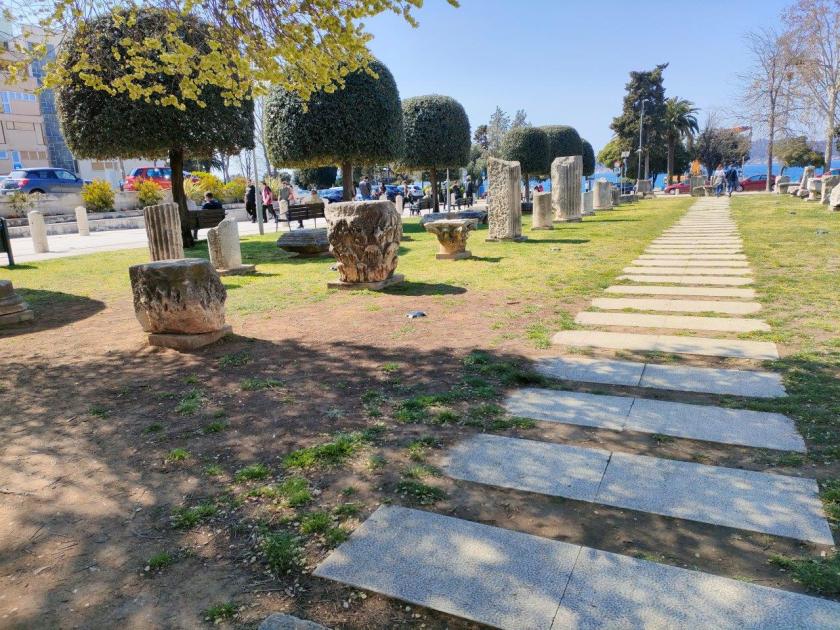
Zadar, historically known as Zara, is one of Croatia’s oldest continuously inhabited cities. Covering an area of about 25 square kilometres, this city, although small, has plenty to offer to its visitors. It is a UNESCO world heritage site, and the most prominent place to visit in Zadar is the ruins of the Roman Forum. Since Zadar is located along the sea, it also offers lovely promenades, beaches and all that goes into a beautiful seaside experience.

At Zadar, we stopped by for an early dinner at Wunderburger. My review of the restaurant is posted here.
After dinner, we checked into our apartment in Zadar.
Accommodation at Zadar
Just like in Dubrovnik and Split, finding parking in the city centre of Zadar is very difficult. So I would highly recommend looking for accommodation that is located at the centre and also has a parking spot. That way, you can reach important locations on foot.
We stayed at the centre of the city, and all the prominent locations, like the Roman Forum, Greetings to the Sun, Sea Organ etc., were just a few minutes walk away.
You can check out accommodation in Zadar here.
Day 8: Take a walking tour of Zadar, then explore on our own; explore the seaside Promenade
We started our day by taking a walking tour of Zadar. Our guide showed us the ruins of Roman Ruins, the pillar of shame, and prominent locations such as the Church of St. Donatus, the Cathedral of St. Anastasia, the Land Gate, Five Wells Square, and the People’s Square, explaining the prominence of these structures. She also guided us to other exciting activities in Zadar, good places to eat, souvenirs to carry back home, etc.

I always find walking tours pretty interesting, and we always prefer doing it as the first thing in any location so that we can use the knowledge from a local to explore the place further.
A walking tour of Zadar can be booked here.
After the walking tour, we explored the old town on our own. We visited the Church of St. Donatus from the inside.

Then, saw a live concert in People’s Square and then stopped by for lunch at Providur near Five Wells Square. My review of the restaurant is posted here.
After lunch, we headed home to rest.
In the evening, we walked along the sea and visited two attractions: the Sea Organ and Greetings to the Sun.
Sea Organ
The Sea Organ is a musical instrument that produces sound from the sea waves. Large marble steps and the sound of different musical notes help you identify the spot easily. Underneath and concealed by the marble steps are tubes and a resonating cavity that produce different musical notes as the sea pushes air through them. Since the waves produce sound, you can experience different notes at different times of the day.
People sit on the steps and enjoy the beauty of the calm sea and the musical notes. The combination truly works like magic.

Another engineering marvel called the Greetings to the Sun is a few steps from the Sea Organ.
Greetings to the Sun
Greetings to the Sun is a 22-meter diameter circle with photovoltaic solar modules underneath. It consists of three hundred multi-layered glass plates placed at the same level as the stone-paved waterfront. The lighting elements installed in a circle are turned on at night to produce a light show.

One can spend as much time as possible along the sea. We spent an entire evening there, enjoying the sunset, before heading home.
Day 9: Visit the Salt Mines near Zadar; Spend some more time in the old city and then head to the airport.
Today was the last today of our holiday in Croatia. Since our flight was in the evening, we had an entire day to spend in Zadar. We started our day by driving to Solana Nin Salt Museum.
Solana Nin:
Located about 16 km north of Zadar old town, the Solana Nin Saltworks are generations old and known for using traditional salt extraction methods. They offer many tour programmes for families, kids and even individuals who want hands-on experience working with salt production. They also have a museum and a shop where you can buy salts of different types ranging from those used for cooking, bathing, therapeutic purposes etc.

You can check more details on their official website.
Since we visited in April, the tours for the season hadn’t started; however, we could visit the museum and buy stuff at the shop.

After the visit, we explored some nearby beaches, which had no tourist crowds and were calm and peaceful.
Then we drove back to the city and had lunch at Harbour Cookhouse in Zadar’s old town. My review is posted here.
After a relaxed lunch, we explored the town a bit more, enjoyed a concert at People’s Square, drooled on the local gelatos and desserts and then decided to head to the airport.
At the airport, we went to the SIXT office and reported that we had arrived. The person checked the car, took the keys and documents, and completed the paperwork, which took about 20 minutes.
Then it was time to wait for the flight.
The flight duration was 1.5 hours from Zadar to Frankfurt.
If you have more days in Zadar, here are some day trip suggestions I have for you:
- Plitvice Lakes Day Trip: This is a 10-hour round trip from Zadar. In this trip, you get to explore the Plitvice Lakes National Park (UNESCO-listed site) on a guided day trip from Zadar with an electric boat ride and a panoramic train tour.

- Island Hopping with swimming, snorkeling and hiking: If you wish for a more active day, take this 4-hour speed boat tour which includes an island-hopping excursion and swimming in crystal-clear waters

- Day Trip to KRKA National Park: I have already shared the details about this earlier in the article.

Our Croatia trip was a lovely one and one of our most unforgettable family holidays.
I have already shared the links for the first three legs of our holiday in Croatia. Do check them out.
To read about other holiday destinations, click here.


Leave a Reply