
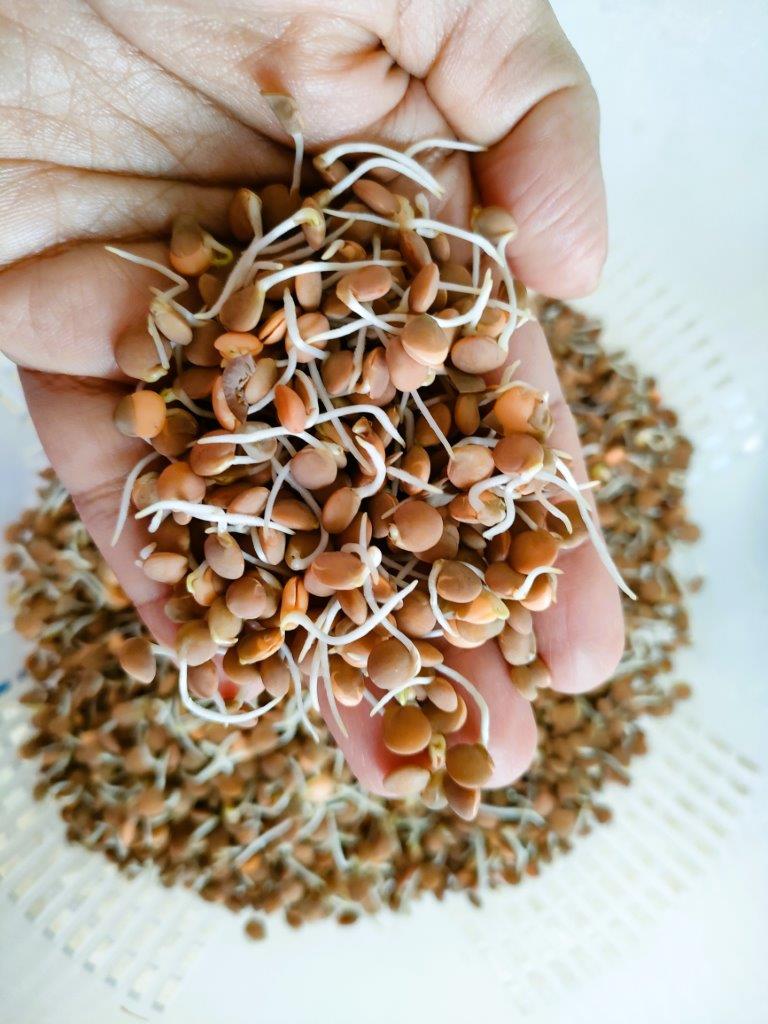
How to make Masoor Dal Sprouts at home
Red lentils with skin or Chilke Wali Masoor Ki Dal, as it is called in Hindi, are legumes that are commonly consumed in India and now in many other parts of the world. This legume is packed with nutrients, is full of antioxidants and is a great source of protein, especially for vegetarians.
Red Lentil sprouts are an excellent addition to your everyday meals. I recently made a delicious Red Lentil Sprouts Dhokla, which tasted great and was a perfect healthy and nutritious breakfast.

In India, Red Lentils (Masoor Dal) are used in various recipes such as curry, dosa, etc. I have also shared a few recipes using Masoor Dal, such as Steamed Lentil and Soybean Dumplings, Masoor Chana Dal, and Mixed Vegetable Khichdi. You might want to check them out.
Also, I have already shared the detailed step-by-step process of making Mung Bean Sprouts and Moth Bean Sprouts. Do check them out too.
Today, I shall share with my readers the simple 3 step process of making Masoor Dal Sprouts at home. But before we do that, let us understand what Masoor Dal is, its nutritional information and the benefits of consuming Masoor Dal Sprouts.
What is Masoor Dal?
Masoor Dal (Red Lentils) is a legume mainly grown in India and Canada. These two countries are the highest producers of red lentils. It grows in pods. After harvesting, the seeds are removed from the pods. The seeds have a shape that resembles a lens. It is brown on the outside and red on the inside. These lentils are consumed in both forms, with and without skin.
Masoor Dal with skin looks as shown in the picture below. This variety is rich in fibre (because of the skin) and is hardier than those without skin( explained below). It also takes time to cook. It is best to soak it for a few hours before cooking it. This variety is used for sprouting.

This second variety of Masoor Dal is de-skinned and split. It looks as shown in the picture below.

This variety cooks fast and is also easy to digest. The most common recipe with this dal is Khichdi, which is a porridge typically served to people who are unwell or sick. Since this dal is easy to digest, it is perfect for people who find it difficult to swallow or digest their food.

What are the nutritional benefits of Masoor Dal?
Red Lentils are a good source of B vitamins, folate, iron, and potassium. They also contain high levels of protein and fibre. When sprouted, their protein content increases, and vegetarians can include this in their diets to fulfil their protein needs. They are nutrient-dense and rich in antioxidants.
What are Masoor Dal sprouts?
Sprouting is the process by which seeds germinate. If you put any seed (which is intact and in its cover) in soil and water it, you will notice that, in a few days, a shoot starts growing from it. If you allow it to grow, it will become a plant.
Masoor Bean Sprouts are, basically, germinated, whole Masoor Legumes.

Can Masoor Dal Sprouts be made at home?
Yes, sprouts are easy to make at home and don’t require much effort.
Is any specialized equipment needed to make Masoor Dal sprouts?
No, you don’t need any specialized kitchen equipment to make sprouts. All you need is a bowl to wash and soak the legume and a sieve/cotton cloth to let the sprouts develop.
How long does it take for a legume to sprout?
It depends on how long you want the shoots to be. For small shoots, 8-10 hours are enough. For longer shoots, 24-48 hours are needed.
What is the process of making Masoor Dal Sprouts?
Making sprouts is a three-step process. Let’s understand step by step how sprouts are made.
Step 1: Wash and soak the lentils for 24 hours.

This is how the lentils look after 24 hours of soaking.


Step 2: Wash the lentils once again. Drain out the excess water. Transfer to a strainer. Cover with a lid and rest it for 8-10 hours.
This is how you must keep the lentils. The lid will help retain moisture. The strainer will allow airflow, and the bowl below can collect any excess water that drips from the beans.

After 8-10 hours, this is how the lentils will look. You will notice tiny shoots growing from each seed.

Mix the seeds with your hand and let them rest for another 24 hours in the same setup.
After 24 hours, this is how the beans will look.


Continue to let them rest for another 24 hours. This is how they will look after another 24 hours of rest.


Now, the sprouts are ready.
Step 3: Wash them once again and use them in any recipe of your choice.
If you have made a big batch and plan to use a portion immediately and use the rest later, don’t wash the portion that will be kept in the fridge. Wrap the sprouts in a moist cotton cloth ( which is dipped in water and wrung out). Tie a knot and keep this pouch in a container with a lid in the fridge. When you want to use them, remove them from the cloth, wash and use them.
Ideally, sprouts should be consumed within 2-3 days.
Can Masoor Dal Sprouts be eaten raw?
Yes, they can be. In fact, it is said that you get the best nutrition from the sprouts when you eat them raw. However, by eating them raw, you risk the chances of consuming the bacteria that sometimes tends to grow in warm, closed conditions (when we make the sprouts). Some people may even find sprouts difficult to digest, leading to stomach cramps, diarrhoea, etc, after consuming them.
So, to be safe, it is best to cook the Masoor Sprouts before consumption. Cooking helps avoid the risk of food poisoning due to unwanted bacteria. Moreover, cooked sprouts taste a lot better than raw ones. You do lose some of their nutritional value, but this is a safer option. You can either boil, steam or lightly saute your sprouts. I find steaming them for about 10 minutes the most efficient way to consume sprouts.
If you don’t have a steamer, take a saucepan and fill it to half its capacity with water. Heat water in the saucepan. When the water comes to a boil, transfer your sprouts to a steel sieve and keep the sieve on the saucepan. Cover it with a lid and cook for 10 minutes. The steam that is generated by boiling water in the saucepan will rise. This steam will cook the sprouts.

Some Recipes with Sprouts
I have already shared the process of making Moth Bean Sprouts and Mung Bean Sprouts. Here are some of the recipes from my kitchen using sprouts: Mung Bean Sprouts Salad, Moth Bean Sprouts Open Sandwich, Moth Bean Sprouts Adai, Mung Bean Sprouts Parantha.
You can use these recipes and replace the sprouts shown in the recipe with any sprouts that you have handy.


Equipment for making Sprouts and cooking them:
Check out recipes from my kitchen here.
Please note that this article contains affiliate links. If you buy using these links, I receive a small commission. This has no effect on the price for you.
Follow me on:


Leave a Reply