
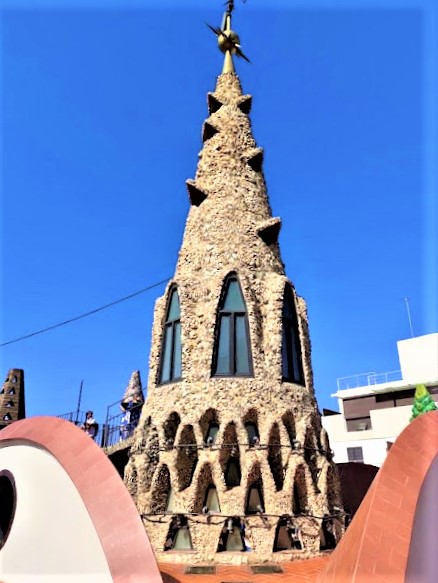
Family Holiday in Barcelona – Our Experience
Visiting Spain had been on the cards for a long time. Finally, during one of the Easter vacations, we got a chance to visit this lovely country. This article is about our seven-day family holiday in Barcelona.
Spain is a preferred holiday destination in Europe, and Barcelona is one of Spain’s most popular destinations. As usual, we started planning about a month before the trip. The tasks included:
- Booking flight tickets.
- Exploring accommodation at an appropriate location and booking the same.
- Researching places to visit and not-to-miss experiences.
In this article, I’m writing about the itinerary we created after researching various blogs and YouTube videos. It also includes our experience, reviews, and learnings. So, let’s start.
Our planned itinerary looked something like this:
Day 1: Travel from Frankfurt to Barcelona. Check-in and relax
Day 2 : Palau Güell, La Rambla, La Boqueria and Park Güell.
Day 3: Gothic Quarter, Beach, Other things that we can decide on the go
Day 4: La Sagrada Familia, Camp Nou
Day 5: Montjuïc
Day 6: Day trip to Montserrat
Day 7: Travel back from Barcelona to Frankfurt
But it went through some changes, and finally, this is all that we ended up doing:
Final Itinerary for a 7-day Holiday in Barcelona:
Day 1: Travel from Frankfurt to Barcelona. Check-in and relax
Day 2: Visit Palau Güell, La Rambla, La Boqueria and Park Güell.
Day 3: Visit Casa Batlló, Casa Milà, Gothic Quarter, Palau de la Música Catalana, Barceloneta Beach
Day 4: Visit La Sagrada Familia and Arc de Triomf. Watch a football match at Camp Nou
Day 5: Visit Montjuïc Castle and Poble Espanyol
Day 6: Visit Palau Nacional, Columbus Monument, La Rambla
Day 7: Travel back from Barcelona to Frankfurt
But before I start writing about the places we visited and the things we did, let me take my readers through some important information regarding travel and stay.
Arriving in Barcelona:
Since we were travelling from Germany, and our city – Darmstadt, is a good 1300 km from Barcelona, we considered trains and flights. As we discovered, the train journey was long and involved multiple changeovers at odd hours. Hence we decided to go for the more convenient option of taking a flight, which involved just two hours of travel. Barcelona is a pretty busy city, and it is very convenient and safe even if one arrives late. So, we booked a Friday evening Lufthansa flight from Frankfurt( FRA) to Barcelona El Prat ( BCN) and landed in Barcelona on the same day, around 11 pm.
Depending on your location, you can check both the train and flight options and see which one works better for you. For train bookings, you can use Deutsche Bahn’s official website.
Note that Barcelona Sants is the main railway station.
Travelling in the City:
Multiple ticket options exist to explore and choose from based on one’s needs and plans. We decided to buy the five-day Hola Barcelona tickets, which allowed us to use the metro and other public transport in the Barcelona Metropolitan area for 120 hours from when we first validated it. It can also be used for airport transfers.

The ticket can be purchased online or at any metro station. If purchased online, a personalized code is sent by email. This code must be entered at any ticketing machine at any metro station to get the card. Once you have the card with you, you can start using it.
You can buy the Hola Barcelona card from any of the two options given below. Buy wherever you get a better deal.
For travelling within the city and visiting the prominent tourist attractions, you can alternatively consider getting on a Hop-on Hop-off Bus. Unlike regular public transport, this bus is meant only for tourists and goes from point to point, covering all the main sights. If you have limited time in the city, getting on this bus can save you much time.

Since we arrived late on Friday evening and had luggage, we decided to take a taxi to reach our homestay. The plan was to validate the Hola Barcelona ticket the following day.
We observed that in Barcelona airport, people were standing near the arrivals area offering taxi rides, suggesting booking Uber or offering other alternatives. We didn’t take any of those. Instead, we exited the airport. Just outside were taxi ranks with officials helping people get a cab outside the terminal gate. (These yellow and black taxis are safe and reasonably priced.) Reaching the city centre cost us under 30 euros, and we arrived in about 20 minutes. You can find more details about city transfers from the airport here.
Another reasonably priced option is to book a bus ride from the airport to the city.

So, the first day of our holiday was all about travelling, reaching Barcelona, unpacking, and getting a good night’s sleep before starting an active holiday!
Accommodation in Barcelona:
Since we are a family with kids already in their teens, having enough space for each of us is essential. Hotel rooms are not spacious enough and restrict everyone to a small room. So, off late, we have started booking homestays and apartments. We usually reserve a flat or house, preferably with an equipped kitchen and a minimum of two bedrooms, so that each of us has our own space and there is always an option of cooking something.
We, as a family, like having a good breakfast and starting our day, and homestays allow us to make simple meals at home. We also like exploring the local supermarkets, finding what’s new, and trying out foods and drinks that are locally available. Homestays are an excellent option for all those who want to add this to their holiday experience.
We stayed very close to the city centre. However, since Barcelona is well connected with public transport, you can go a bit far too. You can find the right accommodation for your needs here.
Now let us move on to Day 2.
Day 2:
Our first place of visit was Palau Güell. Then we visited La Rambla and La Boqueria, followed by Park Guell.
So, we left our house around 9 am, validated our Hola Barcelona ticket at the nearby Metro station, and reached our destination. Since we had about 30 minutes, we picked up a quick breakfast at a nearby cafe on La Rambla and then headed to Palau Güell. Palau Güell is on the street adjacent to La Rambla.
About Palau Güell:
Palau Güell is a residential building constructed around the late 1800s and was architected by the famous Antony Gaudi. Later it was named a UNESCO world heritage site. The wealthy politician and businessman Eusebi Güell owned this property. In 1945, this property was handed over to Diputacio de Barcelona by the daughter of Eusebi Güell on the condition that the palace be preserved. The palace is an important work by Gaudi.
More information about Palau Güell can be found here.
There is an English-guided tour every Saturday at 10:15 a.m. It is not available on any other day. Since we had only one Saturday in Barcelona (which also happened to be our first day), we decided to make this our first destination. We made the booking in advance using this link.
Our tour guide took the group through the different sections of the house, exploring various rooms and explaining essential aspects of the design and construction. The tour lasted about 1-1.5 hours and was interactive and informative. Once it was over, we explored the building independently, took pictures, etc.

We got free around 12:30 and came back to La Rambla. We walked a little, explored the shops and cafes, and reached La Boqueria. We walked around, tried a few short eats, took plenty of pictures, and then headed out, as it was very crowded.

About La Rambla and La Boqueria:
La Rambla is a 1.2 km pedestrian street lined with cafes and souvenir shops. It’s mostly filled with tourists walking, shopping, clicking pictures, or relaxing in cafes enjoying some local delicacies. La Boqueria is an open market on La Rambla, with plenty of shops, restaurants, Tapas bars, and cafes serving fresh local food. Eggs, meat, chocolates, fruits and vegetables, baked goodies, you name it, and it’s there in La Boqueria. It’s a treat for the senses. One can walk around enjoying the sights and smells and click pictures to preserve all these memories forever.

Read more about about La Rambla and La Boqueria.
La Rambla is a great place for walking and exploring shops and cafes, but be aware of pickpocketers. Also, this place is a bit expensive if you want to buy souvenirs. Go to the adjacent streets, and you will get better deals. La Boqueria is an excellent place to get a feel of Barcelona. There is a great variety of foods and drinks, cafes and shops to explore. The atmosphere is lively, but it may feel chaotic to some.
As we walked away from La Rambla, we found relatively less noisy and chaotic restaurants and had a relaxed lunch with Sangria and Tapas at Bar Lobo. My review of this restaurant is available here.
After a relaxing lunch, we decided to head to Park Güell. Since we had the Hola Barcelona Card, we used public transport to reach Park Güell.
About Parc Güell:
Parc Güell is a park located on Carmel Hill that comprises gardens and architectural elements. The highlight is Gaudi’s work—the grand entrance, the terrace, and structures with extensive use of mosaics. The park is so big that one can spend an entire day there if one wants. There are hiking opportunities, viewing areas from which one can get a great view of the city and plenty of photo opportunities around the structures created by Gaudi.
More information about the park is available on the same page as well on the Wikipedia page.

We reached the park using the metro. The metro level is much lower than the park’s, so we had to climb up on foot, which was a bit tiring. I would suggest taking the bus rather than the metro to reach the park to avoid the extra walk because the park is quite big, too. One has to do a good amount of walking in the garden, so coming by bus can save you some energy.
After seeing the park, we took the bus and returned to the city centre.
Note: The park authorities turned back many who intended to buy tickets at the counter because of the huge crowds. So booking in advance is a good idea.
You can book in advance to visit the park using any of the following links. Book wherever you get a better deal.
If you are interested in learning more about the park, you can even book a Skip the Line Guided Tour. It is a 75-minute tour in which a guide meets you at the park’s entrance, shows you around, and explains the different structures.
We spent about 2 hours in the park. It was a wonderful experience and worth climbing a hill on foot to reach. We could have explored more had the weather been better, but we soon got exhausted since it was hot. But the park is certainly worth a visit if you are in Barcelona.
That ended our sightseeing for the day. On our way back, we picked up some ingredients from the local supermarket for dinner and the next day’s breakfast.
Day 3:
For Day 3, we had not made a concrete plan, which meant there were no bookings done, which also meant that we didn’t have to stick to any timelines. We woke up late, had a hearty breakfast, and headed out.
We read about Casa Batlló and Casa Milà- two more notable works by Antoni Gaudi. Since we had explored Palau Güell from the inside the previous day, we decided to see these buildings only from the outside. Using public transport, we reached the nearest Metro station to Casa Batlló, saw it from outside, clicked pictures, and then headed to Casa Milà. We saw Casa Milà also from the outside and then headed to our next destination – The Gothic Quarter.
About Casa Batlló:
Casa Batlló is also a UNESCO World Heritage Site, along with other works by Gaudi. It is presently owned by The Bernat Family, who initiated a restoration of the building in 1995. The facade is a colourful one with a unique and distinguished design. One can see it from the inside too by making a booking online.

You can book a visit using any of the following links. Book wherever you get a better deal.
About Casa Milà:
Casa Milà is also a UNESCO World Heritage site known for its unconventional design. The building was commissioned in 1906 by Pere Milà and his wife Roser Segimon and is Antoni Gaudi’s last residential work.

You can book a visit using any of the following links. Book wherever you get a better deal.
Both works by Gaudi, Casa Batlló and Casa Milà look stunning from the outside. The facade of both buildings themselves is awe-inspiring.
After seeing these two sites, we headed to the Gothic Quarter.
About Gothic Quarter:
The Gothic Quarter is the oldest part of Barcelona and includes the remains of the city’s Roman wall and several notable medieval landmarks. However, contrary to its name, much of the present-day fabric of the Quarter dates to the 19th and early 20th centuries.

On reaching this place, the narrow streets, cathedrals, churches, basilicas, and the remains of the Roman wall remind us of a bygone era. The many cafes and restaurants, musicians performing on the streets, locals shopping, and participants in cultural events create a lively atmosphere.
The entire place has to be explored on foot.
More information about the Gothic Quarter can be found here.
It is a must-visit place in Barcelona. The feel of the area is entirely different from what one gets in the rest of the city. As the old structures and narrow streets slowly transform into modern chick cafes and speciality shops, one experiences the resonation of both the old and the new. It’s an ideal place to spend half a day exploring and getting lost in the streets to find beautiful surprises in every nook and corner.

Like many other tourists, we explored the Gothic Quarter on foot, strolling in the narrow alleys, trying local foods, exploring important landmarks like the Cathedral, remains on the Roman wall, etc. Exploring the whole place took us about 1- 1 1/2 hours. Then we stopped by a nearby restaurant named El Cafè d’en Víctor for lunch for Tapas and Paella. My review of this restaurant is available here.
If you have about two hours, I recommend taking the 2-Hour Gothic Walking Tour. On this tour, a local guide takes you around the place and makes your visit much more meaningful and enjoyable.
After a satisfying lunch, we planned to return home to rest before heading to the beach in the evening. As we were walking, we came across Palau de la Música Catalana. We had read about it earlier and decided to give it a try. We purchased tickets for the audio-guided tour at the counter. Luckily we all were carrying our mobile phones with earphones. The audio guide has to be accessed using the QR code provided by the authorities. They do not offer audio guide sets, nor do they have earphones that one can borrow(they are available in the shop, though), so it is best to carry one’s phone and earphones when visiting this place.
About Palau de la Música Catalana:
Palau de la Música Catalana is a concert hall inaugurated in the early 1900s. The design of the place is elaborate and showcases extensive use of floral and other organic motifs. There is extensive usage of marble, mosaic, ceramic, and glass.
The audio guide lasts about 40 minutes and takes you through all the main parts of the hall, including the facade, the entrance, the vestibule, the foyer, the staircase, and the concert hall.

More information can be found here.
You can book a visit using any of the following links. Book wherever you get a better deal.
Everything in Palau de la Música Catalana is very artistically and aesthetically done and is a treat for the eyes. Despite the various materials and designs incorporated, the overall appearance doesn’t look overwhelming. The audio guide’s content is crisp and clear. It explains everything precisely, ensuring first-time visitors aren’t swamped with facts and data. The staff is also friendly and helpful.

After all the walking, we were tired, so we decided to finally head back home, get some rest, and step out again in the evening. So, in the evening, we went to Barceloneta Beach.
About Barceloneta Beach:
Barceloneta Beach is one of the most popular beaches in Barcelona. It is a sand beach and runs more than 400 meters. A separate elevated walking path runs along the length of the beach, where one can enjoy the sun and the breeze without getting on the sand. There is an open gym, multiple shower options, and plenty of cafes, tapas bars, and restaurants. The beach is usually crowded but clean.
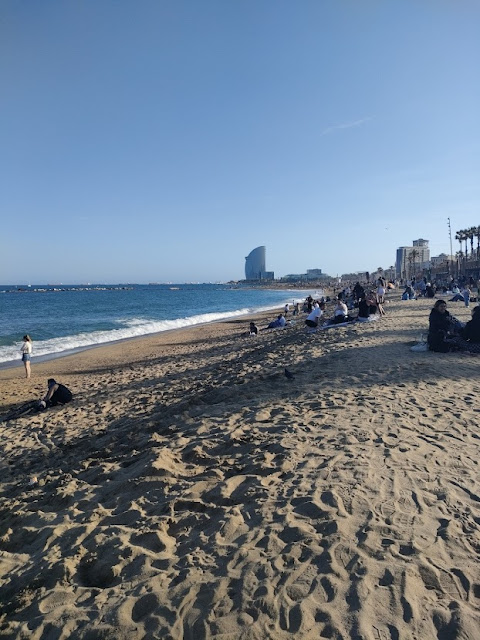
We had a lovely time at the beach. It was clean and well-maintained. Although the water was still cold in April and one couldn’t swim, walking along the beach and enjoying the cool breeze was exhilarating.
By the 3rd day, we were already craving Indian food, so we googled some restaurants nearby and found an excellent Indian restaurant named Rasoi Ghar. My review is here
After satisfying ourselves with great food, it was time to go home for a good night’s sleep!
Day 4:
On Day 4, we booked an audio tour for the La Sagrada Familia at 10:30 a.m. When one googles the top places to visit in Barcelona, La Sagrada Familia is the first suggestion. So, as first-time visitors, we had to add it to our itinerary.
About La Sagrada Familia:
La Sagrada Familia is a Roman Catholic Basilica in Barcelona. It is considered Antony Gaudi’s most significant work. The construction of this basilica started in the late 1800s and continues to this day. It started as a result of donations by many people from Barcelona and volunteer work by architects, planners, and many others involved in the building and construction. A year after the start of construction, there was a rift between the construction management and del Villar ( the architect).
As a consequence, del Villar resigned. The project was proposed to Martorell ( the structural engineer), who, too, declined as he had been involved in the rift. This Gaudís name was proposed. Now, Gaudi took ownership of conceptualizing, designing, and planning the new facades.

The Sagrada Família currently has two display facades: The Nativity facade and the Passion facade. These facades have portals depicting events from Christ’s life. The third facade, the facade of Glory, is under construction.
More information on La Sagrada Familia can be found here.
It is best to buy tickets online, as getting tickets at the counter for the desired day of the visit is almost impossible because of the place’s popularity and the vast crowds. We bought our tickets online and installed the La Sagrada Familia app in advance, too.
You can book a visit using any of the following links. Book wherever you get a better deal.
After visiting La Sagrada Familia, it was clear why it is Barcelona’s most popular tourist spot. The structure is massive and beautiful. The facades have beautiful depictions of the life of Christ. The intricate yet elaborate work on the walls, pillars, and ceilings reflects the amount of thought and planning that has gone into executing this massive project. The audio guide lasts about 45 minutes and gives the visitor a good understanding of the history, building and architectural elements, design, and future of the La Sagrada Familia. One can also visit the museum in the basement and the souvenir shop, which has an excellent collection ranging from fridge magnets, postcards, and books to miniature models of the La Sagrada Familia. This place is a must-visit when in Barcelona.

After completing our tour of the La Sagrada Familia, it was time for lunch. Like many other tourist destinations, this place is surrounded by cafes and restaurants. We went to Cafe Buenas Migas, which was located a street away from the La Sagrada Familia. My review of the cafe is here
After lunch, we decided to walk on the streets, explore shops, take pictures, etc.
Our next destination was Arco de Triunfo de Barcelona. Although we could have taken public transport, we decided to walk down. It took us about 30 minutes to reach the Arc de Triomf.
About Arco de Triunfo de Barcelona:
Architect Josep Vilaseca built the Arc de Triomf i Casanovas as the main access gate for the 1888 Barcelona World Fair. The arch is made of red brick and has many sculptures, stone carvings, and allegories written by poets. From the arch, a wide promenade leads to Ciutadella Park, which now occupies the site.

More information can be found here.
There is no access fee to visit the Arc de Triomf. One can see the place, take a walk along the promenade, buy paintings by local artists, or get a family photograph with the Arc de Trompf in the background. The sculptures and stone carvings done on red brick look beautiful. It is a beautiful place to stroll on the promenade or enjoy a picnic at Ciutadella Park.
We spent about 1 hour and then returned home for rest before we stepped out again for the biggest highlight of our holiday – A football match at Camp Nou!
After having an early dinner at home, we headed to Camp Nou.
About Camp Nou:
Camp Nou is a football stadium in Barcelona. It opened in 1957 and has been the home stadium of FC Barcelona. With a seating capacity close to a lakh, it is the largest stadium in Spain and Europe.

More information can be found here.
Check out FC Barcelona match tickets here.
We had planned to see a match at the stadium between FC BARCELONA – CADIZ CF. There was a huge crowd, and the cheering, clapping and whistling added to all the fun of enjoying the game with other football fans. If you are a football fan, you should not miss this place. The match started at 9 pm and ended around 11:30 pm.
If the match doesn’t fall during your holiday, you can book a museum and stadium tour. You can book the tickets using any of the following links.:
After the match, we headed home.
Day 5:
Today was the day to head toward Montjuïc. We woke up late, had a relaxed breakfast, and then got ready.
About Montjuïc:
Montjuïc is a hill in Barcelona. It translates to “Jewish Mountain” and is named so because remains of a medieval Jewish cemetery have been found there. There are plenty of places to see, but we chose three: Montjuïc Castle, Poble Espanyol, and Palau Nacional.
Our first destination was Montjuïc Castle. To reach the castle, there are two options.
- Take the metro and reach the Funicular station. From there, take the funicular to the base of the hill. Either climb up the hill, take the bus or take the cable car. The Funicular and Bus tickets are included in the Hola Barcelona Card. The cable car ticket has to be purchased. You can choose to buy the cable car – one-way or two-way tickets.
- Take the metro and reach the Cable car point. From there, purchase tickets for two legs—from the Cable car starting point to the base of the hill and from the base to the castle. These are one-way or two-way tickets: cable to the base of the hill and then a hike up to the castle OR cable car up to the castle—you can make your choice.

We took the metro and reached the funicular station. From there, we took the funicular and reached the base of the hill. We took a one-way cable to the top of the caste. The cable car ride we took from the base of the hill to the top to reach the castle was beautiful. We enjoyed the breathtaking views of the valley as our cable car progressed towards the top of the hill towards the castle. After seeing the castle, we returned on foot. It is a downhill walk and very easy. On the way back, because we were on foot, we explored many other things like viewing points, fountains, a small restaurant, and a play area for children. Also, the surroundings were beautiful, with many beautiful blooming flowers and tree-lined paths. I would highly recommend coming back on foot.
If you wish to go both ways with a cable car, you can book the Montjuïc Cable Car Roundtrip Ticket here.
About the Montjuïc Castle (Castel de Montjuïc):
Montjuïc Castle is an old military fortress, with roots dating back from 1640, built atop Montjuïc hill. It currently serves as a Barcelona municipal facility. It is open to the public and offers fantastic city and port views. One can also see the city’s important landmarks from various viewpoints.

More information about the castle can be found here.
Tickets can be purchased here.
We spent around 2 hours at the castle and then started walking down towards the base of the hill.
It is worth the effort to reach the castle. The castle is beautiful and well-maintained. On a good weather day, one can easily spend about half a day walking around, exploring all the parts of the castle, capturing pictures of the city from different viewing points, or relaxing and refreshing oneself with food and drinks at a small cafe located inside the castle.
From the base of the hill, we took the bus and returned to the city centre.
It was already lunchtime. We wanted to stop by a good restaurant for a meal. Since we had not planned anything, we did a quick Google search, found Poble Espanyol nearby, and decided to go there. We took the bus from the base of the hill, and after a couple of stops, we reached Poble Espanyol.
About Poble Espanyol:
The Poble Espanyol (meaning Spanish town) is an open-air architectural museum built for the 1929 Barcelona International Exposition. The museum consists of 117 full-scale buildings replicated from different places in Spain, forming a small town. It also contains a theatre, restaurants, artisan workshops, a contemporary art museum, and restaurants and cafes.

Since we were looking for a restaurant, we decided to go to a restaurant and see Poble Espanyol after the meal.
Poble Espanyol is the only place in Barcelona that we found disappointing. Some positives were that the place is nice and well-maintained, the concept is terrific, and the representation of various parts of Spain is done aesthetically. The staff was courteous. We visited an Italian restaurant where the food was average, but the service was quick, and the staff was friendly. But we couldn’t find local artisans at work (one of the experiences promised as a part of the visit). The workshops were there, but no one seemed to be at work ready to showcase their creations. Most of the restaurants were closed, leaving very few options, and the place had a general deserted feel. We saw ‘Fiesta’ – a 10-minute program about the festivals of Spain. It was average. We also visited the Fran Daurel art museum, which was a bit of a disappointment.
After lunch, we walked around a little and returned. It was already evening, and we were tired, so we returned home.
Day 6:
Although we had planned a day trip to Montserrat today, we skipped it as there were a few more things that we wanted to see in the city.
We started our day by visiting Montjuïc National Palace.
About Montjuïc National Palace ( Palau Nacional):
Located amidst serene surroundings on the hill of Montjuïc stands the majestic Montjuïc National Palace – an important landmark of Barcelona. The structure is colossal and looks grand. Due to its size and location, it can be spotted from far away. It was the leading site of the 1929 International Exposition and has a collection of over 5,000 artworks. Several steps lead up to the palace. Multiple fountains along the way enhance the majestic appearance of the palace. After climbing up, breathtaking city views create plenty of photo opportunities. There are cafes and small shops too at the top.

More information can be found here.
If you wish to see it from the inside, tickets can be purchased using any of the following links:
We didn’t visit it from the inside but spent almost 2 hours climbing to the top and enjoying the views. The imposing structure is undoubtedly impressive and awe-inspiring. It is a not-to-miss destination in Barcelona.
After getting down, we headed towards the Columbus Monument.
About the Columbus Monument:
The Columbus Monument is a 60-m tall monument to Christopher Columbus at the lower end of La Rambla. It was constructed in honour of Columbus’ first voyage to the Americas. Today, the monument reminds us of Columbus’s difficult journey and the support he received from Queen Isabella I and King Ferdinand V for achieving this feat. At the very top of the monument stands a 7.2 m tall bronze statue that depicts Columbus pointing towards the New World with his right hand while holding a scroll on the left. Eight bronze panels depict important scenes in Columbus’s first voyage to the Americas.
The tower stands tall at the end of La Rambla. The location is excellent, and the monument looks impressive. The scenes depicted on the bronze panels illustrating critical stages before and after Columbus’s voyage are comprehensible and fascinating.

More information can be found here.
We spent about 15 minutes admiring the monument, understanding the scenes depicted on the bronze panels, and headed to La Rambla for Lunch.
We stopped by Ideal Restaurant on La Rambla. I can say that it was most definitely the worst restaurant in Barcelona. Everything was overpriced, the food was not tasty, and the experience was not great! I have left a review of the restaurant here:
Since the beach was close by, we walked there for a while and finally had an early dinner at the same Indian restaurant, Rasoi Ghar, that we had visited some days back. It was a great experience. We returned home and did our packing.
Day 7:
Today was the day we left Barcelona and headed home. We used our Hola Barcelona card and took the metro straight to the airport. We took our flight to Frankfurt and reached Darmstadt around 5 p.m.
Our holiday in Barcelona was superb and unforgettable. All the places we saw, the foods we tried, the people we encountered, and the good and bad experiences enriched us. I recommend to my readers to visit Barcelona if they get a chance. If you have any questions, please reach out to me.
If you have more days in Barcelona, I would suggest you add these few things to your itinerary:
Also, check out these photo galleries, where I have posted many more pictures taken in Barcelona during our holiday:
So, this was all about our personal experience in Barcelona. You might also find my article on the Top 14 places to visit in Barcelona helpful.
Also, check out my articles about other holiday destinations here.
If you like this content and would like to receive my posts in your mailbox, please subscribe.


Leave a Reply